
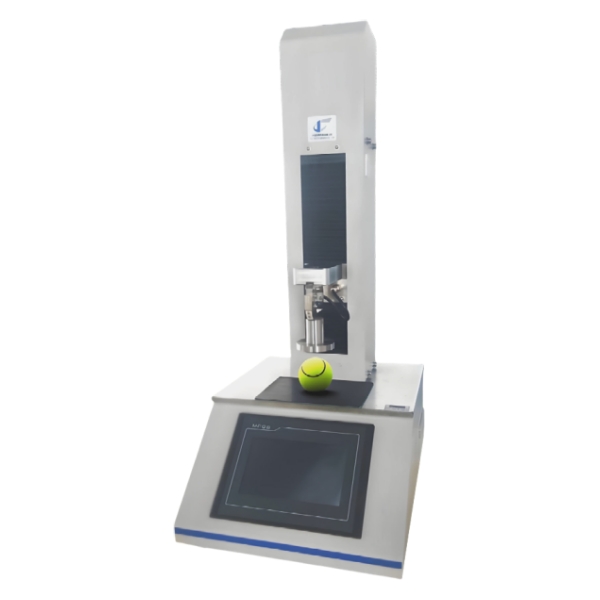
In the world of professional and recreational tennis, ball consistency plays a crucial role in ensuring fair play and athlete performance. To achieve this, manufacturers and quality inspectors rely on precise testing equipment like the Tennis Ball Compression Tester. This instrument evaluates how much a tennis ball deforms under a specific force, reflecting its elasticity, resilience, and playability.
According to the International Tennis Federation (ITF) и GBT 20045, compression testing is one of the most essential quality indicators for tennis balls. A ball that’s too soft or too hard can significantly impact gameplay and does not meet certification standards.
Cell Instruments TBCT-01 Tennis Ball Compression Tester
For laboratories and manufacturers seeking a professional and compliant solution, the Cell Instruments TBCT-01 Tennis Ball Compression Tester offers a reliable and automated testing platform.
Key advantages include:
- Full compliance with GBT 20045 и ITF TB 03/01.
- High-precision force sensors for deformation measurement.
- User-friendly software interface for automatic data acquisition and report generation.
- Consistent pre-compression control, eliminating operator variability.
- Durable design suitable for continuous laboratory or factory use.
Main Parameter:
| Диапазон на изпитване | 20kg |
| Stroke | 250 mm (without plates) |
| Speed | 1–500 mm/min (adjustable) |
| Displacement Accuracy | +/-0.01mm |
| Force Accuracy | ±0.5 % F.S. |
| Plate Diameter | 70mm(up to 100mm) |
| Control & UI | PLC + 7″ HMI touchscreen |
| Data Output | Screen, microprinter (opt.), RS‑232 (opt.,PDF export) |
| Power | AC 110~220V 50/60Hz |
By integrating TBCT-01 into production or inspection processes, users can ensure that each ball meets international playability standards, improving product reliability and brand credibility.
Importance of the Tennis Ball Compression Tester
A Tennis Ball Compression Tester ensures that every ball meets standard specifications for deformation under controlled conditions. The deformation reflects the balance between internal pressure and rubber resilience, which directly affects speed, bounce height, and control during play.
For instance, professional tennis tournaments only accept balls that pass the ITF Rules of Tennis for compression and rebound. Non-compliant balls can alter the speed of rallies or create unfair advantages on court. Therefore, precise testing is essential not only for manufacturers but also for tournament organizers, quality inspection agencies, and sports equipment laboratories.
Testing Principle and Procedure
The testing principle is derived from the Deformation Test Method ITF TB 03/01, also specified in GBT 20045, which defines the mechanical compression process of tennis balls.
Before measurement, the ball is pre-compressed through a distance of 2.54 cm (1 inch) three times along each of three perpendicular axes. This pre-conditioning process removes the “set” from the ball and ensures consistent test results.
Once pre-conditioning is complete:
- The ball is placed between two parallel platens of the compression tester.
- A predetermined force is applied along the diameter of the ball.
- The resulting forward and return deformation are measured accurately.
- The values are compared to standard ranges defined by ITF and GBT 20045.
To qualify for tournament use, a ball must also pass through or be restricted by specific ring gauges under its own weight, ensuring dimensional accuracy:
- Ball Type 1 & 2: Must pass through 6.86 cm and not through 6.54 cm.
- Ball Type 3: Must pass through 7.30 cm and not through 7.00 cm.
- Stage 1 (Green Ball): Must pass through 6.86 cm and not through 6.30 cm.
These precise tolerances ensure consistent diameter and deformation properties across production batches.
Relation to ITF Rules and GBT 20045
Both the ITF Rules of Tennis и GBT 20045 emphasize that ball deformation must be tested using an approved compression device such as a modified Stevens Machine or equivalent. The compression tester must feature:
- Two identical platens aligned axially and parallel.
- A force-measuring device capable of recording deformation under applied load.
- A rigid and calibrated structure ensuring measurement repeatability.
Сайтът Tennis Ball Deformation Tester based on these principles provides accurate, reproducible data crucial for verifying ball conformity with ITF approval requirements.
Why Compression Testing Matters
Compression testing provides objective data on the feel and response of a tennis ball. Too much deformation means the ball is too soft, leading to slower speed and less rebound. Too little deformation indicates over-hardness, which can increase player fatigue and reduce control.
Through the Tennis Ball Compression Tester, these subtle variations can be quantified and corrected early in production. This testing approach helps manufacturers maintain a stable performance profile across batches—an essential requirement for ITF certification and customer satisfaction.
Сайтът Tennis Ball Compression Tester is indispensable for ensuring the structural integrity and performance uniformity of tennis balls. By adhering to ITF Rules of Tennis и GBT 20045, manufacturers can confidently produce balls that meet international standards for professional play.
For organizations seeking dependable, accurate, and compliant testing solutions, the Cell Instruments TBCT-01 provides an ideal choice—balancing precision, efficiency, and reliability.
 BG
BG  EN
EN  AR
AR  CS
CS  DA
DA  DE
DE  EL
EL  ES
ES  ET
ET  FI
FI  FR
FR  HU
HU  ID
ID  IT
IT  JA
JA  KO
KO  LT
LT  LV
LV  NB
NB  NL
NL  PL
PL  PT
PT  RO
RO  RU
RU  SK
SK  SL
SL  SV
SV  TR
TR  UK
UK