
Geomembrane Elongation at Break Test
ASTM D6693
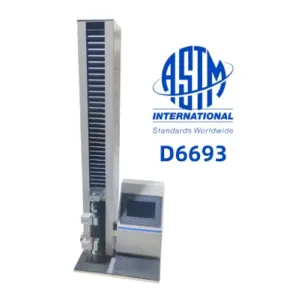
Сайтът geomembrane elongation at break test is a key mechanical evaluation used to assess how geomembrane materials respond to tensile stress until rupture. This property directly reflects a geomembrane’s flexibility, ductility, and resistance to deformation, which are essential for applications such as landfill liners, reservoirs, mining containment, and environmental protection systems.
Standardized by ASTM D6693, this test method provides a controlled and repeatable approach for measuring tensile strength and elongation performance of nonreinforced geomembranes. For manufacturers, testing laboratories, and quality inspectors, understanding this method ensures reliable quality control and meaningful material comparison.
ASTM D6693 Geomembrane Tensile Elongation at Break Test Using a Breaking Force Tester
ASTM D6693 defines an index tensile test for determining elongation at break and related tensile properties of nonreinforced polyethylene and flexible polypropylene geomembranes. The method focuses on material behavior under a constant crosshead speed, making it suitable for production control and specification verification.
In the geomembrane elongation at break test, a dumbbell-shaped specimen is stretched using a calibrated тестер за разрушаваща сила until rupture occurs. During this process, the instrument continuously records tensile force and extension, forming a complete load–elongation curve. From this curve, tensile break strength and percent elongation at break are derived.
Although the method does not measure true strain using extensometers, ASTM D6693 ensures reproducibility by strictly controlling specimen geometry, test speed, and environmental conditions. As a result, tensile and elongation data remain comparable across laboratories when procedures are followed consistently.
Why the Geomembrane Elongation at Break Test Is Critical
The geomembrane elongation at break test provides insight into a material’s ability to accommodate stress without sudden failure. In real-world installations, geomembranes often experience settlement, thermal expansion, and localized stress concentrations. High elongation at break generally indicates improved flexibility and tolerance to deformation.
ASTM D6693 highlights that tensile and elongation results depend strongly on specimen preparation and test conditions. Therefore, this test plays a crucial role in:
-
Quality control during geomembrane production
-
Verification of compliance with technical specifications
-
Comparative evaluation of different geomembrane formulations
Geomembrane Elongation at Break Test Procedure and Calculation of Elongation at Break
The test procedure follows a clear and logical sequence:
-
Mount the specimen in the grips of the breaking force tester, ensuring precise axial alignment
-
Set the crosshead speed to 500 mm/min for polyethylene and flexible polypropylene geomembranes
-
Apply tensile force continuously until specimen rupture
-
Record force and extension data throughout the test
The instrument captures the full tensile response, including the breaking force and extension at rupture. Many flexible geomembranes do not exhibit a clear yield point, making elongation at break the most critical reported value.
ASTM D6693 provides clear calculation rules to ensure consistency:
-
Tensile break strength equals the breaking load divided by the original minimum specimen width
-
Percent elongation at break equals the extension at rupture divided by the original gauge length, multiplied by 100
When necking occurs before fracture, the standard allows calculation of ultimate elongation, ensuring that the geomembrane elongation at break test still reflects true material behavior.
Common Testing Issues and How to Reduce Variability
Several factors can influence geomembrane elongation at break test results:
-
Grip slippage due to improper clamping
-
Specimen misalignment causing uneven stress
-
Thickness variation across specimens
To reduce variability, laboratories should maintain calibrated equipment, apply consistent specimen preparation methods, and use a stable breaking force tester designed for polymer materials.
Suitable Tensile Testing Equipment for ASTM D6693
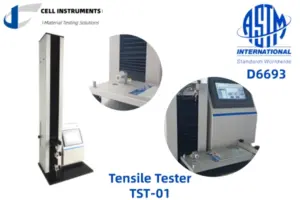
Reliable results require a tensile tester capable of precise force and displacement control. The Инструменти за клетки Тестер за опън TST-01 supports ASTM D6693 testing by offering stable crosshead speed, accurate load measurement, and adaptable grips for geomembrane specimens.
Beyond geomembrane elongation at break test applications, the TST-01 also serves testing needs in plastics, packaging, textiles, and other flexible materials, making it a versatile solution for multi-industry laboratories.
Заключение
Сайтът geomembrane elongation at break test specified in ASTM D6693 remains a fundamental method for evaluating tensile and elongation performance of nonreinforced geomembranes. By following standardized preparation, testing, and calculation procedures, laboratories can generate consistent, comparable, and meaningful results.
For organizations focused on quality assurance and material performance, combining ASTM D6693 expertise with a reliable breaking force tester such as the Инструменти за клетки TST-01 ensures confidence in geomembrane behavior under real-world tensile stress.
FAQs
- What does the geomembrane elongation at break test measure?
The geomembrane elongation at break test measures how much a geomembrane specimen stretches before it ruptures under tensile load. It reflects the material’s flexibility, ductility, and ability to withstand deformation during installation and service. - Which materials are suitable for testing under ASTM D6693?
ASTM D6693 applies to nonreinforced geomembranes, primarily polyethylene (PE) and flexible polypropylene (fPP) materials, with thicknesses typically ranging from 0.25 mm to 6.3 mm. - Why is ASTM D6693 considered an index test rather than a design test?
ASTM D6693 uses crosshead displacement instead of direct strain measurement. While this approach ensures repeatability for quality control and specification compliance, it does not provide true strain data required for structural design analysis. - How many specimens are required for a valid geomembrane elongation at break test?
For isotropic geomembranes, at least five specimens are tested. For anisotropic materials, ten specimens are required—five in the machine direction and five in the transverse direction—to capture directional behavior. - What is the specified test speed in ASTM D6693?
The standard specifies a test speed of 500 mm/min for polyethylene and flexible polypropylene geomembranes. Maintaining this speed is essential for obtaining comparable elongation at break results.
 BG
BG  EN
EN  AR
AR  CS
CS  DA
DA  DE
DE  EL
EL  ES
ES  ET
ET  FI
FI  FR
FR  HU
HU  ID
ID  IT
IT  JA
JA  KO
KO  LT
LT  LV
LV  NB
NB  NL
NL  PL
PL  PT
PT  RO
RO  RU
RU  SK
SK  SL
SL  SV
SV  TR
TR  UK
UK