
أ film pendulum impact tester is a crucial tool for assessing the toughness and mechanical durability of flexible materials such as plastic films, laminates, foils, and composites. These materials are widely used in packaging, electronics, medical devices, and construction, where resistance to puncture and rupture directly affects product performance and reliability.
Designed to simulate real-world impacts, this testing method is based on standardized procedures like ASTM D3420, which quantifies the energy absorbed by a specimen when struck by a pendulum. The data obtained enables manufacturers to optimize material selection, enhance packaging protection, and meet regulatory expectations for performance and safety.
Standardized Testing Methods: ASTM D3420 and Spencer Impact Test
To ensure consistent and repeatable results, the pendulum shock test must be performed according to internationally recognized standards. One of the most widely accepted is ASTM D3420, which defines the methodology for measuring the pendulum impact resistance of plastic film.
This standard involves clamping a film sample across a circular aperture and striking it with a pendulum-mounted hemispherical head. The energy required to puncture the specimen is calculated from the angular displacement of the pendulum post-impact. Two main procedures are defined:
Procedure A: Uses a 60 mm aperture and a 25.4 mm impact head
Procedure B: Known as the Spencer impact test, uses an 89 mm aperture and a 19.0 mm head
Both procedures help determine how much energy the film can absorb before failure—crucial for evaluating film impact resistance and predicting in-use performance.
Other related test methods include:
Spencer impact testing equipment (Procedure B variant)
ASTM standards for impact testing of plastics, such as D1709 and D4272
NF T54-116 و GB/T 8809, which are regional equivalents covering film pendulum impact testing
These standards guide quality control professionals in selecting reliable testing protocols for a wide range of films and flexible packaging materials.
Applications:Where Film Pendulum Impact Testing Is Used
ال impact resistance of plastic film is critical in environments where sudden mechanical stress, sharp objects, or high-speed contact may occur. Industries that benefit from this testing include:
Flexible Packaging: Ensuring medical pouches and food packaging can resist puncture during logistics
Automotive & Aerospace: Verifying composite films and interior components withstand mechanical shock
Construction Materials: Testing roof membranes, foils, and house wraps for physical durability
Electronics & Printing: Confirming coated papers or laminates hold up to bending and abrasion
Each application demands confidence in a material’s pendulum impact resistance, which can only be achieved through rigorous lab testing and validated instrumentation.
PIT-01 Film Pendulum Impact Tester: Precision Meets Efficiency
To meet the increasing demands of impact testing, أدوات الخلية يقدم PIT-01 Film Pendulum Impact Tester. This advanced system is engineered for high-accuracy, real-time analysis of puncture resistance in thin films and laminated structures.
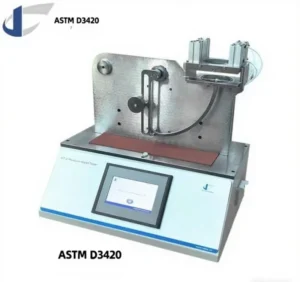
Key features include:
ASTM D3420 compliance with both Procedure A and B support
PLC control + 7-inch HMI touchscreen for intuitive operation
Auto pendulum release to maintain consistent initial force
Pneumatic clamping to reduce sample slippage and operator variation
Multiple impact heads for different material strength levels
Data auto-statistics (max, min, avg) and built-in micro-printer for immediate results
This level of automation and precision makes the PIT-01 ideal for R&D labs, production QC stations, and certification testing across a range of materials.
Best Practices for Conducting the Pendulum Impact Resistance Test
Professionals conducting film pendulum impact testing should follow these best practices to ensure meaningful data:
Condition specimens at 23 ± 2°C and 50 ± 10% relative humidity (per ASTM guidelines).
Calibrate the pendulum using known energy values before test runs.
Use proper clamping (O-ring or pneumatic) to avoid slippage, which leads to test variability.
Test at least five samples, report average energy absorbed, and include standard deviation for consistency.
Monitor for physical signs of slippage or failure patterns, as they affect material classification.
These steps help ensure that the results reflect true material performance rather than testing variability.
Conclusion: Why Film Pendulum Impact Testing Matters
In a competitive manufacturing landscape, understanding how materials behave under dynamic stress is non-negotiable. The film pendulum impact tester offers a standardized, reproducible way to evaluate the impact resistance of plastic film, ensuring performance, compliance, and safety.
Whether validating packaging films, optimizing materials for high-performance environments, or complying with ASTM D3420 standards, Cell Instruments’ PIT-01 provides a dependable and efficient solution for professionals in quality assurance and product development.
 AR
AR  EN
EN  BG
BG  CS
CS  DA
DA  DE
DE  EL
EL  ES
ES  ET
ET  FI
FI  FR
FR  HU
HU  ID
ID  IT
IT  JA
JA  KO
KO  LT
LT  LV
LV  NB
NB  NL
NL  PL
PL  PT
PT  RO
RO  RU
RU  SK
SK  SL
SL  SV
SV  TR
TR  UK
UK